

18 Oct How to Use AI to Make Life Easier (and Stay Safe Doing It)
AI chatbots can save you hours each week.[1] They can also be wrong, pushy, hallucinate[2], or used against you.[3] This guide shows you how to get the benefits and avoid the traps. This is AI 101 (if you’re one of my clients using AI to write code, this article is not for you)!
Part 1: Ten ways AI makes life easier
1. Explain things in plain words. Paste in a confusing letter, bill, or medical term. Ask: “Explain this like I’m 12. Then tell me what I need to do next.” Never paste something with your personal information on it![4]
2. Draft the hard email. Say who it is for, what you want, and the tone. Try: “Write a polite but firm email to my landlord about the broken heater. Keep it under 120 words.”
3. Summarize long things. Paste an article, a contract, or a long email thread. Ask for five bullet points and any dates or deadlines.
4. Plan meals and shopping. Tell it what is in your fridge, who you are feeding, and any diet limits. Ask for a week of dinners and a grocery list.
5. Plan a trip. Give your dates, budget, and interests. Ask for a day-by-day outline. Then confirm hours, prices, and bookings on the official sites.
6. Learn something new. Ask it to be your tutor. Say: “Teach me the basics of home budgeting. Quiz me after each step.”
7. Prepare for a big conversation. Practice a job interview or a salary talk. Ask it to play the other person and give you feedback.
8. Fix your writing. Paste your draft. Ask it to fix errors and keep your voice.
9. Break big tasks into steps. Try: “I need to clean out my garage this weekend. Give me a plan in small steps.”
10. Brainstorm. Ask for 20 ideas for a gift, a party theme, or a business name. Pick the best two and ask for more like them.
A simple formula for better answers
Give it four things:
- Who you are: “I’m a beginner.”
- What you want: “A one-week workout plan.”
- Limits: “No equipment. 20 minutes a day.”
- Format: “A table.”
If the first answer is off, say what to change. You can reply to it like a person.
Part 2: How to stay safe
Never share sensitive details. Do not type in Social Security numbers, bank or card numbers, passwords, or full medical records. Treat the chat box like a postcard, not a sealed letter.[4, 5] Remove names and account numbers before you paste in a document.
Check anything that matters. AI can sound sure and still be wrong. It can invent facts, quotes, laws, and sources.[2, 6] For health, money, legal, or safety questions, use AI to get oriented. Then confirm with a professional or an official source. You can ask it to never give you an answer unless it is sure and can cite its source.
Ask for sources, then open them. Some AI tools make up links and article titles.[2, 6] Click each one. If you cannot find it, do not trust it.
Do not treat it as a doctor, lawyer, or financial advisor. It can help you prepare good questions. It cannot know your full situation or take responsibility for the result.
Be careful with feelings. AI tends to agree with you. If you ask whether your plan is smart, it may say yes too easily.[7, 8] Ask it to argue against you. Say: “What are the strongest reasons this could go wrong?” Also, I personally instructed my AI to stop complimenting me. It’s making us very narcissistic.
Know the scams that use AI.
- Voice cloning. Scammers can copy a loved one’s voice from a short clip.[9] If a “family member” calls in a panic and asks for money, hang up. Call them back on their usual number. Set a family code word for extra protection.[3]
- Fake video calls. Faces and voices can be faked live, and I can no longer distinguish an AI video vs. a real one without an AI tool[10]. In 2024, a company in Hong Kong lost about $25 million after an employee joined a video call full of deepfaked coworkers.[11] Verify money requests through a second channel.
- Perfect phishing emails. The old clue of bad grammar by the Nigerian prince is gone.[3] Do not click links in unexpected messages. Go to the website yourself.
- Fake reviews and fake experts. AI can write thousands of glowing reviews.[12] Look for specific details and mixed opinions.
Check your settings. Many AI apps can save your chats or use them to train future models.[4, 5] Look in the privacy settings and turn off what you do not want.
Use a simple rule. Before you rely on an AI answer, ask: “What happens if this is wrong?” If the answer is “not much,” go ahead. If it is “I lose money or my health suffers,” verify first.
Part 3: For fun, how AI tricks people
AI is not trying to fool you (it can’t think like that), but it can mislead you in funny and serious ways.
The lawyer and the invented cases. In 2023, two New York lawyers filed a court brief with legal cases a chatbot had made up. The cases looked real, with names and citations. A judge fined them.[6] The lesson: AI writes what sounds right, not always what is right.
The chatbot that invented a refund policy. In 2024, an Air Canada chatbot gave a customer wrong information about bereavement fares. A tribunal ordered the airline to pay $812.02 in damages..[13] Companies are responsible for what their bots say, but you should still keep screenshots.
The strawberry problem. Ask some chatbots how many times the letter “r” appears in “strawberry.” For a long time, many got it wrong with total confidence.[14, 15] AI reads in chunks of words, not letters.[14] It can write a poem and still miscount.
The flattery trap. Show a chatbot a mediocre business plan and ask what it thinks. You may hear that it is “a fantastic idea.” Ask for the weaknesses and you will get a different answer.[7, 8]
The photo that never happened. AI images have shown the Pope in a white puffer jacket[16] and fake disaster scenes.[17] Zoom in. Check hands, text in the background, and odd shadows. Then search for the same image from a trusted news source.
The confident wrong answer. Ask a chatbot about a person or event that barely exists and it may make up a detailed story.[18] Try it with your own name. You may be surprised by the biography it gives you.
Your quick safety checklist
- Share nothing private.
- Verify anything important.
- Open every source it gives you.
- Ask it to disagree with you.
- Call back before sending money.
What AI is and what it isn’t
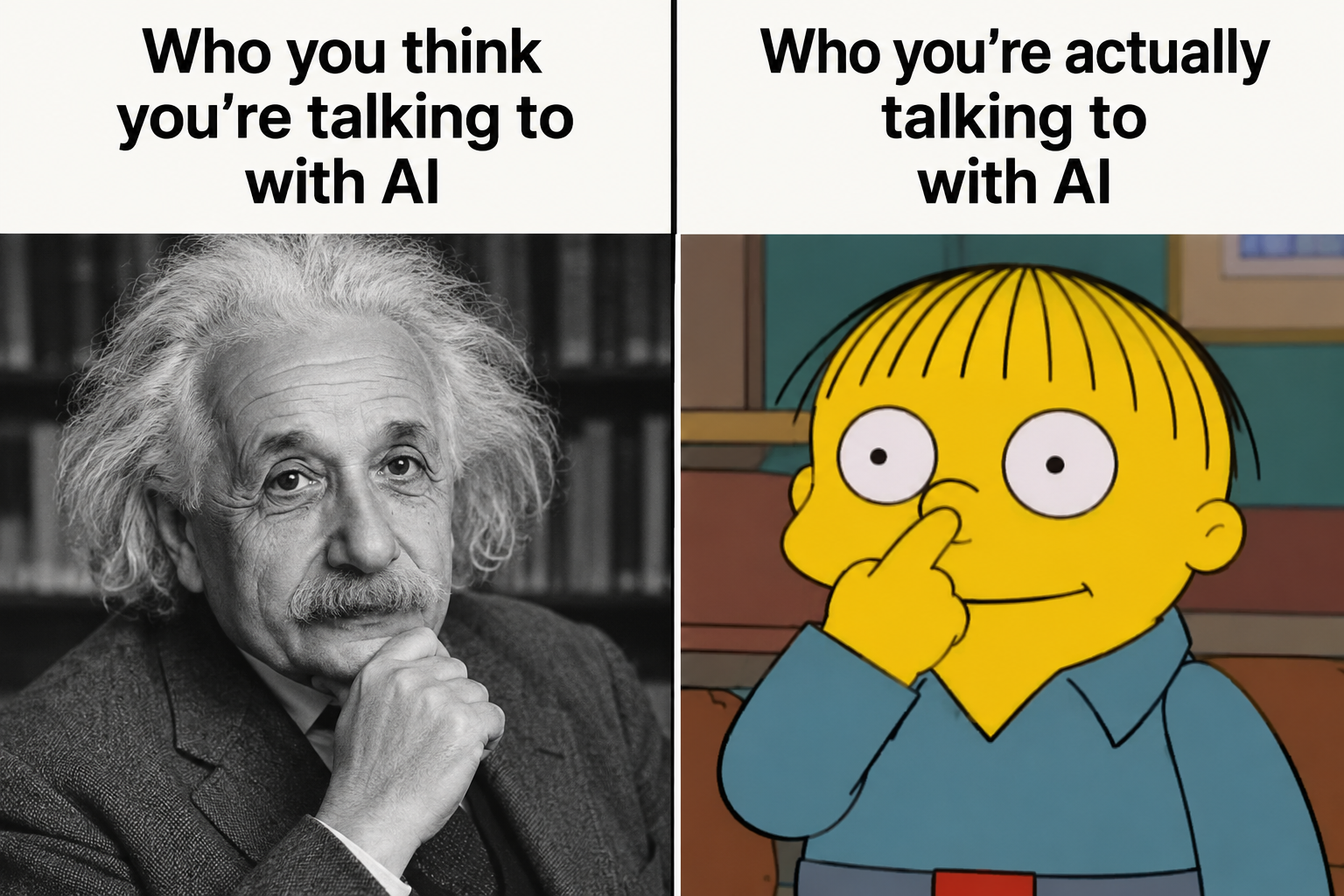
(Meme created with ChatGPT)
Here’s what a chatbot actually is: a language model. It was trained on an enormous amount of writing, and it learned which words tend to follow which other words. When you ask it a question, it builds the answer one word at a time, picking whichever word fits best next.[19] It is NOT thinking or reasoning the way you do. It doesn’t understand your situation, it doesn’t check its facts, and it has no idea when it’s wrong. That’s why it can sound completely sure of itself and still be off. Think of it as a very fast writer with a great memory for patterns, not a person weighing the evidence. Use it to draft, explain, and brainstorm. Then check anything that matters before you act on it.
AI runs in huge data centers that use electricity and water.[20, 21] One short text request uses very little.[22] But millions of requests add up[21], and image and video tools use far more than text.[22, 23] I’ll admit that most of the uses in this article are basic, and many are things you could do yourself in a minute or two. So before you open a chatbot, weigh it. Is the time you save worth the resources it takes?
You don’t have to avoid AI, just do your best to use it on purpose. Write one clear request instead of several scattered ones. I skip it for quick tasks you can handle on my own. For example, yes, you can set up “agents” who can do things for you, such as find a restaurant that meets certain criteria and then make me a reservation for four on Friday.[24] But that’s also something that I can look up and make that phone call on my own. I’m not so busy that I can’t do those things for the good of the environment. We each have to weigh our actions against our values, and that’s true for all things in life!
Tell me how this guide worked for you
Did you learn something new? Was any part confusing? Which tip will you try first? Reply with your answers. Your feedback will help make the next guide clearer.
Sources
[1] Bick, Alexander, Adam Blandin, and David Deming. “The Impact of Generative AI on Work Productivity.” Federal Reserve Bank of St. Louis, On the Economy, February 27, 2025. https://www.stlouisfed.org/on-the-economy/2025/feb/impact-generative-ai-work-productivity
[2] Dahl, Matthew, Varun Magesh, Mirac Suzgun, and Daniel E. Ho. “Large Legal Fictions: Profiling Legal Hallucinations in Large Language Models.” Journal of Legal Analysis, vol. 16, 2024. https://law.stanford.edu/publications/large-legal-fictions-profiling-legal-hallucinations-in-large-language-models
[3] FBI Internet Crime Complaint Center. “Criminals Use Generative Artificial Intelligence to Facilitate Financial Fraud.” Alert I-120324-PSA, December 3, 2024. https://www.ic3.gov/PSA/2024/PSA241203
[4] Stanford Institute for Human-Centered AI. “Be Careful What You Tell Your AI Chatbot.” October 15, 2025. https://hai.stanford.edu/news/be-careful-what-you-tell-your-ai-chatbot
[5] OpenAI. “How your data is used to improve model performance.” OpenAI Help Center. Accessed October 14, 2026. https://help.openai.com/en/articles/5722486-how-your-data-is-used-to-improve-model-performance
[6] Van Voris, Bob. “Phony ChatGPT Brief Leads to $5,000 Fine for NY Lawyers.” Bloomberg Law, June 22, 2023. Reports on Mata v. Avianca, Inc., No. 22-cv-1461 (S.D.N.Y.). https://news.bloomberglaw.com/bloomberg-government-news/chatgpt-phony-legal-filing-case-gets-lawyers-a-5-000-fine
[7] Anthropic. “Towards Understanding Sycophancy in Language Models.” October 23, 2023. https://www.anthropic.com/research/towards-understanding-sycophancy-in-language-models
[8] Chrobak, Ula. “AI overly affirms users asking for personal advice.” Stanford Report, March 26, 2026. Reports on Cheng et al., published in Science. https://news.stanford.edu/stories/2026/03/ai-advice-sycophantic-models-research
[9] Puig, Alvaro. “Scammers use AI to enhance their family emergency schemes.” Federal Trade Commission Consumer Advice, March 20, 2023. https://consumer.ftc.gov/consumer-alerts/2023/03/scammers-use-ai-enhance-their-family-emergency-schemes
[10] FBI Internet Crime Complaint Center. “FBI Warns of Scammers Impersonating the IC3.” Alert I-072026-PSA, July 20, 2026. https://www.ic3.gov/PSA/2026/PSA260720
[11] Magramo, Kathleen. “British engineering giant Arup revealed as $25 million deepfake scam victim.” CNN, May 16, 2024 (syndicated by ABC17 News). https://abc17news.com/money/cnn-business-consumer/2024/05/16/british-engineering-giant-arup-revealed-as-25-million-deepfake-scam-victim/
[12] Federal Trade Commission. “Federal Trade Commission Announces Final Rule Banning Fake Reviews and Testimonials.” August 14, 2024. https://www.ftc.gov/news-events/news/press-releases/2024/08/federal-trade-commission-announces-final-rule-banning-fake-reviews-testimonials
[13] Moffatt v. Air Canada, 2024 BCCRT 149. British Columbia Civil Resolution Tribunal, February 14, 2024. https://decisions.civilresolutionbc.ca/crt/crtd/en/525448/1/document.do
[14] Jog, Chinmay. “The ‘strawberrry’ problem: How to overcome AI’s limitations.” VentureBeat, October 12, 2024. https://venturebeat.com/ai/the-strawberrry-problem-how-to-overcome-ais-limitations
[15] Schoon, Ben. “ChatGPT finally knows how many ‘R’s are in ‘strawberry,’ but confident mistakes remain.” 9to5Google, April 28, 2026. https://9to5google.com/2026/04/28/chatgpt-strawberry-logic-fix-problem/
[16] Thompson, Sarah. “Fact Check: ‘Pope Drip’ Image Is NOT Real — Photo of Pope Francis In White Puffer Coat Is An AI Creation.” Lead Stories, March 27, 2023. https://leadstories.com/hoax-alert/2023/03/fact-check-image-of-pope-francis-in-white-puffer-coat-is-not-a-real-photo-its-an-ai-creation.html
[17] “Fake viral images of an explosion at the Pentagon were probably created by AI.” NPR, May 22, 2023. https://www.npr.org/2023/05/22/1177590231/fake-viral-images-of-an-explosion-at-the-pentagon-were-probably-created-by-ai
[18] “ChatGPT’s bizarre child murder claims about Arve Hjalmar Holmen leave some questions unresolved.” The Decoder, 2025. Reports on a March 2025 complaint by the privacy group noyb to Norway’s data protection authority. https://the-decoder.com/chatgpts-bizarre-child-murder-claims-about-arve-hjalmar-holmen-leave-some-questions-unresolved/
[19] Burtell, Matthew, and Helen Toner. “The Surprising Power of Next Word Prediction: Large Language Models Explained, Part 1.” Georgetown Center for Security and Emerging Technology, March 8, 2024. https://cset.georgetown.edu/article/the-surprising-power-of-next-word-prediction-large-language-models-explained-part-1/
[20] Ren, Shaolei, and Amy Luers. “The Real Story on AI’s Water Use and How to Tackle It.” IEEE Spectrum, September 10, 2025. https://spectrum.ieee.org/ai-water-usage
[21] U.S. Department of Energy. “DOE Releases New Report Evaluating Increase in Electricity Demand from Data Centers.” December 20, 2024. Summarizes Shehabi et al., “2024 United States Data Center Energy Usage Report,” Lawrence Berkeley National Laboratory, LBNL-2001637. https://www.energy.gov/articles/doe-releases-new-report-evaluating-increase-electricity-demand-data-centers and https://escholarship.org/uc/item/32d6m0d1
[22] O’Donnell, James, and Casey Crownhart. “We did the math on AI’s energy footprint. Here’s the story you haven’t heard.” MIT Technology Review, May 20, 2025. https://www.technologyreview.com/2025/05/20/1116327/ai-energy-usage-climate-footprint-big-tech/
[23] Heikkilä, Melissa. “Making an image with generative AI uses as much energy as charging your phone.” MIT Technology Review, December 1, 2023. https://www.technologyreview.com/2023/12/01/1084189/
[24] Krol, Jacob. “OpenAI’s first AI Agent is here, and Operator can make a dinner reservation and complete other tasks on the web for you.” TechRadar, January 23, 2025. https://www.techradar.com/computing/artificial-intelligence/openais-first-ai-agent-is-here-and-operator-can-make-a-dinner-reservation-and-complete-other-tasks-on-the-web-for-you